A couple years ago, I met up with my dear friend Bill Boyle on the back patio of a brewery in downtown Detroit. We talked about basketball for a while, but when the topic turned to Something Else - as it always does with Bill - he flipped the script on me. He said that he’s “religious not spiritual.”
Bill broke it down while we stood by the fire, sipping Red Rye IPAs.
The Latin root of religion means “to be bound.” What we are bound to is non-negotiable and uncircumstantial. When we are bound to something that goes way back, we become grounded and centered.
Religion is what anchors us in a world of chaos and confusion and come-and-go spiritualities that depend on what's trending.
I think one big reason that a lot of people are resistant to religion is that it shares the same root as obligation. In a world of limitless options, it can easily feel like obligations inhibit our freedom. Bill told me that the opposite is true.
Bill said that he is bound to his Zen Buddhist practice, an ancient tradition that leads to love and liberation – for himself and others. He told me that when someone makes time to sit on their mat and clear their mind in silence for just five minutes every day, it is exponentially better for them than not doing it at all.
Bill meditates twice a day for a lot longer than five minutes – and a couple times a year, he goes on silent retreats for five days at a time.
A couple weeks ago, Bill wrote that Zen is not about detaching from the mess of this world and just remaining calm in the face of fascism and genocide. Zen is about remaining present to the mess of this world and showing up as whole and messy as we are able to – as affected, alive, transformed people responding from a place of deep love.
Bill is bound to Something Else that colors everything he does and every aspect of who he is. That’s the point of religion. Bill knows that if he's not bound to Zen Buddhism, he'll drown in the obligations of supremacy stories that script America.
I once heard Dr. Butch Ware lament that most of his fellow Muslims in the West are, in reality, bound to the scarcity logic of consumption and production. “Capitalism is their religion,” he said, “and Islam is their ritual observance.”
The same could be said – much louder – for the vast majority of American Christians.
*****************************
The first followers of Jesus called their religion "the way," which in the original Greek, also means the road, or the path. The disciples of Jesus were bound to the path that Jesus paved. But today, that path has been re-routed by the propaganda and social pressures of neoliberal capitalism, nationalism, imperialism and Zionism.
Look around. Western Christians – by and large - are more bound to the stock market, status symbols, the mortgage, the profit motive, property rights, patriotic expressions, access to cheap oil, and the creation of a settler colony for chosen people than they are to doing justice, loving mercy and walking humbly with God.
Christianity has been coopted.
The first followers of Jesus were bound to the cross. This instrument of torture and death became the logo that Christians used to promote their scandalous commitment to a pattern of life that inverted the values of empire with the paradox of Love.
Jesus told his disciples that they should not even consider joining his movement unless they were willing to deny themselves and take up the cross and follow his lead. The only people that the Roman empire crucified were traitors, like Jesus, who refused to pledge allegiance to Caesar and his supremacist human hierarchy of values.
Jesus was a Jewish general contractor from a little-known Palestinian village called Nazareth. He did not create a new religion. He was firmly rooted in the tradition of the Hebrew prophets, the revolutionary underground movement inaugurated by Moses and Miriam, and carried forward by Elijah, Elisha, Ezekiel, Jeremiah, Isaiah, Micah, Malachi and others.
In the Gospels, Jesus was called a prophet, and he quoted from the prophets, who offered an alternative model of authority.
The prophets released the weary and weighed down from the oppressive obligations of the wealthy and powerful.
The prophets empowered the weary and weighed down to lighten their load by getting yoked to Something Else.
Jesus described the prophetic way as “narrow” because he knew full well that only a few would be willing to walk it. He knew his path would never be popular. Because it's so paradoxical.
Jesus proclaimed that there’s a Power greater than empire that is eternally bound to the poor in spirit, the pure in heart, the peacemakers, those who are meek, merciful and in mourning, and those who hunger, thirst and are persecuted for justice.
James the brother of Jesus wrote that true religion is about looking out for those who have the least status in society and keeping oneself untainted from the world. James was beheaded by ruling elites a few decades after his brother was crucified by them.
Jesus taught that those who try to save their lives – who protect their position and status - will lose their souls. He said that the greatest are those who serve, that the last will be first, and that the humblest among us will be exalted.
*****************
St. Paul persecuted the first followers of Jesus. Until he got blindsided by the light.
Paul said that his conversion was like a crucifixion. He died and Christ rose up in him. He said that his new life in the flesh was bound to being faithful to “the Son of God” who loved the people so much that he gave himself up for them.
There was only one Son of God in first century Palestine: Caesar.
Paul had the audacity to claim that the crucified one stole the emperor’s throne. Paul said that his allegiance to this resurrected Reality caused him to suffer the loss of all things. He now regarded all these things as rubbish. Paul could release the rubbish because he was bound to Something Else.
Paul never stopped being Jewish. He just opted out of the Jewish establishment. He went from being a well-regarded Pharisee to a prophetic pain in the ass. Just like Jesus.
In one of his letters, Paul proclaimed that God’s foolishness is wiser than human wisdom, and God’s weakness is stronger than human strength. He was paraphrasing the prophet Jeremiah, who confronted empire’s emphasis on wisdom, strength and wealth with Something Else: steadfast love, justice and righteousness.
Fifteen years ago, bible scholar Walter Brueggemann wrote a helpful little book called Journey to the Common Good. In it, he says that biblical religion is bound to an either/or.
We are either bound to the wisdom, strength and wealth of the world - or we are bound to the steadfast love, justice and righteousness of God.
Brueggemann unpacks the Hebrew words to clarify the meaning of this divine trifecta:
Steadfast Love (hesed): standing in solidarity, honoring commitments, being reliable towards all partners.
Justice (mispat): making sure that every member of the community has access to resources and goods for the sake of a viable life of dignity.
Righteousness (tzedakah): actively intervening in social affairs, taking an initiative to rehabilitate society, responding to social grievance, correcting every humanity-diminishing activity.
Brueggemann said that this trifecta comes up all over the Hebrew prophets and that they overlap so much that even when one of the words comes up, we can assume that the others are right there too.
In the Gospel of Matthew, when Jesus quotes the prophet Hosea – I desire steadfast love, not sacrifice – we know he’s calling justice and righteousness into the room too. We know this because we see all three of these concepts constantly coming up in his life and teachings. We know this because all three of these concepts got him crucified.
The cross is what the wise, strong and wealthy give to the traitors who bind themselves to those who have no value in the empire, who make sure that everyone has access to resources that make for a dignified life, who actively intervene in social grievances and the humanity-diminishing activities of the wealthy and powerful few who run the empire.
**********************
For the first two decades of my Christian discipleship, I was bound to a Christ that was counterfeited by neoliberal capitalism, nationalism, imperialism and Zionism.
In early adulthood, as I studied the scriptures and critically engaged the ideologies of empire, the tension between the religion of America and the Jesus of the Gospels became too much to bear. The cognitive dissonance was tearing me apart.
The good news is that the word religion also shares the same Latin root with the word ligament, which binds bone to muscle in our bodies. Pledging allegiance to principalities like neoliberal capitalism, nationalism, imperialism and Zionism inevitably tears the ligament that binds us to the soul of the world – to what Dr. King called “the inescapable network of mutuality.”
This is a serious injury.
A few years ago, Lindsay broke her ankle and tore some of her ligaments. After her first day of rehab, she limped into our condo with a large packet of daily exercises and proclaimed, “This is going to be a full-time job!”
It is a full-time job to heal from religion that rips the soul apart. Deconstruction is a start. But then we must do the work of reconstructing it – or replacing it altogether.
One of the best places to begin this long process is the Black freedom struggle.
Howard Thurman, an author, activist, pastor and mentor to the Civil Rights Movement, once wrote that his ancestors, enslaved Africans who became followers of Jesus, “undertook the redemption of a religion that their masters had profaned in their midst.”
To profane is to counterfeit what is sacred, to turn a religion rooted in steadfast love, justice and righteousness into a hierarchy of have gots and have nots.
To redeem is to buy something back and set it free.
The Great Black Redemption of Christianity started as a conspiracy, a secret unlawful gathering, down by the riverside, safely out of sight from plantation owners and white pastors, where these true “believers” blended the Exodus narrative and Gospel stories with the liberative indigenous religious traditions of Africa.
Black Christians were bound to the cross - which was something they intimately experienced on a daily basis for centuries - at the behest of white Christians.
In his bookThe Cross and the Lynching Tree, Dr. James Cone wrote that the gospel is not a rational concept to be explained by a theory of salvation, but a story about God’s presence in Jesus’ solidarity with the oppressed, which led to his death on the cross.
Cone said that when American Christians place the cross alongside the lynching tree, they can see Jesus in new light, and they will be empowered to break rank with white supremacy and every form of injustice.
***********************
In the 4th century, Cyril the bishop of Jerusalem wrote about new converts performing a rather peculiar obligation. Cyril prescribed nude baptisms. It is possible that this is the way it was from the very beginning of the prophetic Jesus movement.
It seems like Paul had this image in his mind when he wrote about stripping off the old self and being clothed with a new self, bound to compassion, kindness, humility, meekness, patience, and, last but not least, love – which binds everything together in complete harmony.
Paul proclaimed that, in an imperial context, being clothed with crucified Love puts everything into a paradoxical situation. The only thing we truly have is what we take off and give away.
We are treated as impostors, and yet are true;
We are sorrowful, yet always rejoicing;
We are poor, yet make many rich;
We have nothing, and yet possess everything.
We are like fragile clay jars that contain this greater Power, this feral Force, this Great Mystery. Crucified Love can only shine through when we are cracked open.
I am bound to this divine paradox, in all my glorious imperfection.
The good news is that crucified Love has the power to compost our deaths, losses and so-called failures. We can let wonder replace the fear. Because this divine Force grows our wings out of our wounds.
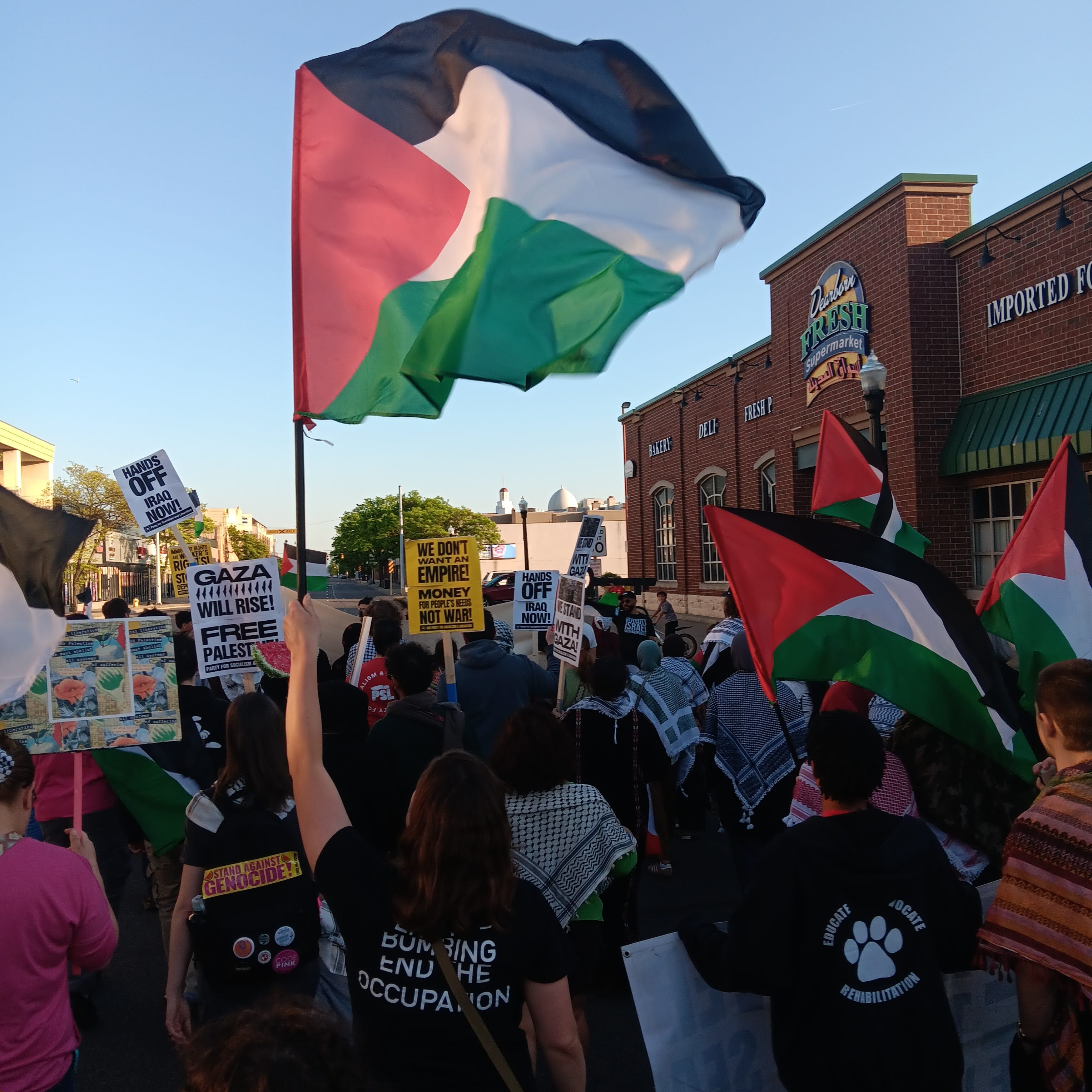
On Friday, the Nakba Day march in the streets of Dearborn, MI.