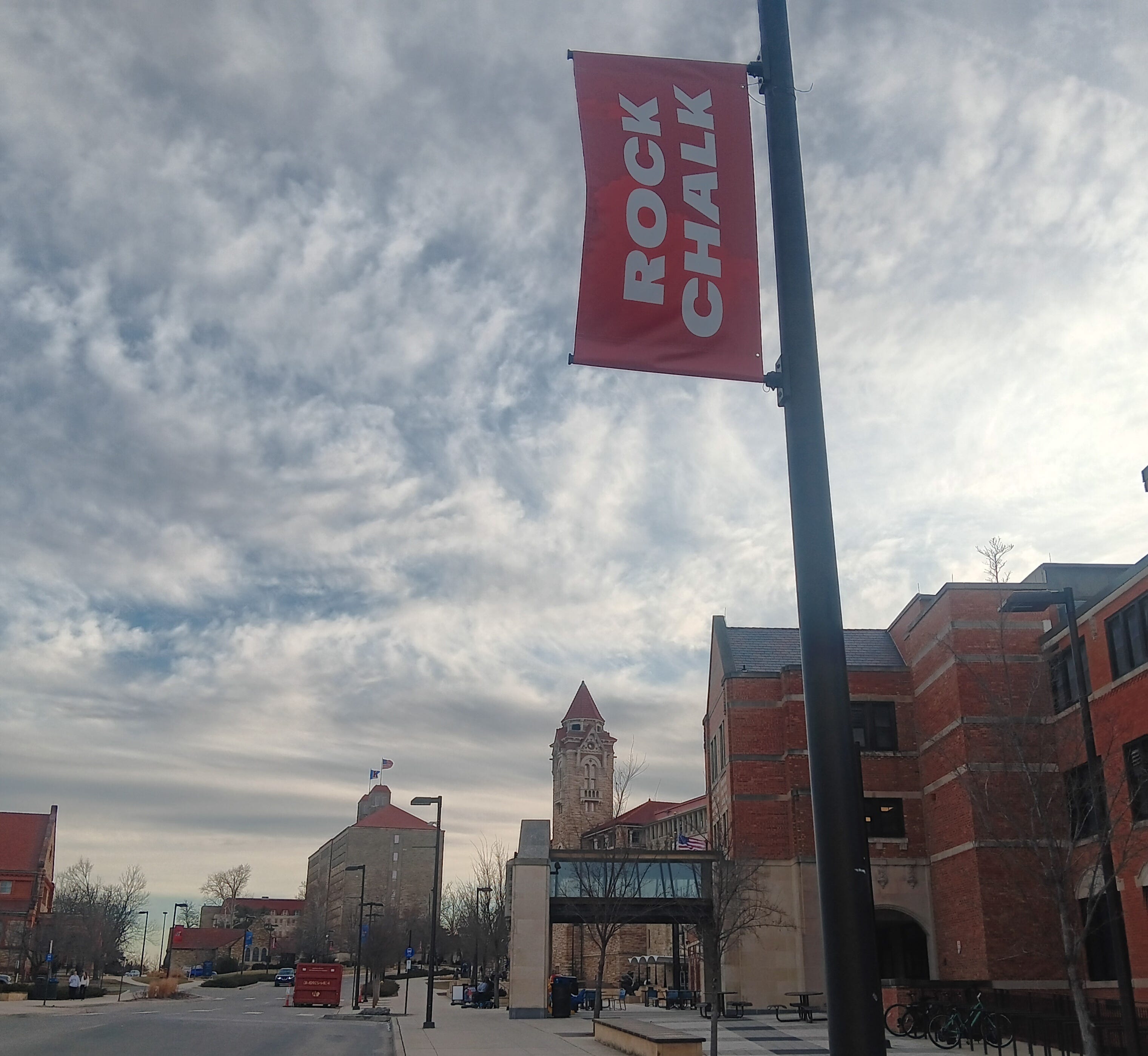
Earlier this month on Kaw and Shawnee land (Lawrence, Kansas).
0:00
-13:10
A couple weeks ago, I kicked-off a cross-country road trip in California, the land of 187,000 unhoused people and 186 billionaires. I packed up an old minivan with treasures that, for decades, had been taking up too much space in our moms’ garages.

Artifacts from high school and college.

Professional pics from our wedding.

Framed portraits that Nana painted.

Old clothes, no longer worn, but soaked with too much nostalgia to part with.

The kneeling seat that my dad used at his desktop computer.

A table passed down to my mom from her Aunt Ruth.

The wooden padded armchair that Lindsay’s great-great-grandmother died in.

On that first morning, in a minivan full of memories, the sun cracked the horizon just east of Barstow. A few hours later, in the desert of Northern Arizona, I drove past the shuttered Cholla Power Plant, right off Interstate 40. It reminds road-warriors of what that coal ash – with its arsenic, cobalt, boron, fluoride, lithium, molybdenum, radium, selenium and sulfate - did to the water supply of the Navajo Nation.

From Cholla, I drove due east, following the three-hundred-mile route of dozens of forced deportations of the Navajo in the 19th century. Along the way, I passed forts built by the US military to establish a “civilized” presence in the area. These forts facilitated the forced walks and broken treaties and stolen land and polluted water.

These forts looked the other way when Jeffrey Epstein moved into a 26,700 square foot mansion built on the 10,000-acre Zorro ranch on Pueblo land just north of my route. Epstein set up a sex-trafficking operation, right there, in the middle of nowhere, in a part of the country that most Americans do not even know exists.

People on pedestals flew in private jets that literally landed on Epstein’s own runway. Epstein was a college dropout. Where did he get all that money? The short answer is that he was well-connected to a Zionist network that used his charisma and cunning to coerce and blackmail wealthy and powerful people into supporting a settler-colonial project that treats Palestinians just like the Navajo.

*******************
I drove a thousand miles on that first day.

I stacked boxes to carve out a little space to sleep in the minivan full of memories at a Love’s truck stop in Tucumcari, New Mexico. I woke up at 4:30 and staggered inside to buy a mediocre cup of coffee for the road.

I jumped on Highway 54, an unlit two-lane road that runs northeast through farms and cattle ranches in New Mexico, Texas, Oklahoma and Kansas. Every single vehicle coming the other way was a big rig semi.

The sun came up with splendor just south of Dalhart, Texas. Right off the road, I could see the barbed wire of a huge prison.

The day before I traveled through this corner of Texas, Leqaa Kordia was rushed to a hospital after suffering seizures at the Prairieland Detention Center south of Dallas. Leqaa Kordia is a 33-year-old Palestinian who was abducted by ICE last Spring, in retaliation for protesting the genocide of her people in front of Columbia University.

Multiple times, the courts have ordered her release. But the forts won't let her go.

Leqaa Kordia suffered the first seizure of her life after almost a year of poor sleep, inadequate nutrition and stress. When she was in the hospital for three days, she was chained to the bed. When she asked why she was being chained to the bed, the officer answered, “Because I said so.”

***********************
The day after Leqaa Kordia suffered a seizure, I arrived in Lawrence, where I spent my last two years of undergrad as a history major at the University of Kansas.

In Lawrence, the main drag is called Massachusetts Street to honor the “founders” of the city. In the middle of the nineteenth century, white abolitionists moved to the hills of eastern Kansas from New England for one reason: to make sure that more people would vote to make Kansas a free state.

Of course, what’s left out of this heroic scripting of history is the fact that forts facilitated the removal of the Kaw, Shawnee and other Indigenous people from that land to make the city of Lawrence and its renowned university a reality.

I hadn’t been to Lawrence since 2023. It was on that last trip that I noticed for the first time that Mass Street was bookended by a supremacy story.

On the north end of the downtown district, there’s a park overlooking the Kansas River. It had a gigantic boulder with a plaque honoring the so-called “pioneers” of this place. This huge sacred red rock is what the Kaw people call In ‘zhúje ‘waxóbe.

It is pronounced “in ZHOO-jay wah-HO-bay.”

For thousands of years, the twenty-ton boulder marked a place of prayer downriver. However, in 1929, white people used a crane to uproot it and then haul it on a train twenty miles east to Lawrence to celebrate the city’s 75th anniversary.

Mass Street runs south, through blocks of retail and dining establishments, right into Haskell Indian Nations University, which was originally founded as one of the first Native boarding schools built in the United States.

Two decades after the Long Walk of the Navajo, the federal government shifted its official policy from removal to assimilation. Children living on reservations were uprooted from their homes and sent hundreds of miles away to schools like Haskell where their Indigenous lifestyle was literally beaten out of them. They were forced to learn English, cut their hair and convert to Western Christianity.

A century before the forts refused to investigate Jeffrey Epstein’s rape ranch, thousands of Indigenous children were emotionally, physically and sexually abused in residential schools all over the country. The conditions were so harsh at Haskell that more than a hundred elementary-aged kids died.

For people on pedestals, all this collateral damage was worth it. Because the “savages” were assimilated to white Christianity, which was the only thing that could save their souls.

*********************
Out in the deserts and prairies of Turtle Island, the horror is hidden in plain sight. It interrogates the “noble legacy” of Western Civilization, which has been sanctified by the simplistic theology that I saw on a sign in front of Calvary Baptist Church, just south of Pratt, Kansas:

Jesus thought you were worth leaving heaven for.

White settlers turned Jesus the dark-skinned Palestinian Jewish prophet into the White Christ who only cares about saving sinners so that they can come join him in heaven when they die.

When the victims of genocide, ethnic cleansing and forced displacement ask the White Christ why all of this is allowed to happen to them, he responds, "Because I said so."

People on pedestals pray to the White Christ for His cheap grace. They love to quote the passage from John’s Gospel where Jesus proclaims, “I am not of this world.”

For centuries, they've used this text to distance themselves from complicity in the horror. Their White Christ is not from here – and one day, they will leave all this mess behind too.

The only hope they offer is in a future rapture. Until the White Christ returns in glory, genocide, ethnic cleansing and forced displacement will be inevitable - and the perpetrators will be unaccountable.

**********************
The good news is that, if we linger on the words of the Gospel a little longer, they have the power to compost Something Else.

When Jesus said that he is not of this world, “this world” is “cosmos.” In the context of his teaching and ministry, it makes a lot more sense to translate this Greek word as “this system,” which is also what “cosmos” referred to in the first century.

Jesus was not aligned with the dirty, rotten imperial system – and his followers weren't either. This is why he was crucified by people on pedestals, and why he told the disciples that they must carry their crosses too.

If faith, hope and love are not incarnated in the White Christ, but instead in a poor dark-skinned Palestinian Jewish prophet who gets crucified for confronting a system scripted by supremacy stories, then it changes everything.

If we read the right-side of the bible through this lens, then Something Else emerges.

The greater Power is not up there distancing, but down here differentiating.

This alternative Authority does not rely on forts, mansions, boarding schools, reservations, detention centers and surveillance.

It is an incarnated Reality that lives in solidarity with the abducted, abused, craned up and chained down.

I do not believe that Love will save the world through a rapture, but with many ruptures.

A rapture is disposable and self-protective. It runs away from responsibility.

Ruptures take over everything in the vicinity. They are messy and must be tended to.

The more I unpack rapture theology, the more I become absolutely convinced that people on pedestals are fixated on the final buzzer because they are afraid that "because I said so" will catch up to them.

But if the End Times is just another imperial fairy tale, and the game is never over, then Love's long process of redemption will play out.

All the truth, goodness and beauty that are buried in the past will eventually rise up.

And the system will rupture at its seams.