Once a week, I drive up to the cemetery on the north end of Detroit where Rosa Parks and Aretha Franklin are buried. I pull in and park my 2009 Toyota Corolla under the same giant spruce. I pivot to the passenger seat and write. I call it the graveyard shift. In the winter, I start the car every thirty minutes or so to turn on the heater for a while.
Last week, I went for a run through the cemetery and I came upon two Canadian geese. The momma hissed at me as I ran by. When I got about twenty feet past her, she flew right by my ear. It scared the hell out of me and I kept running. When I looked back, she was flying right for my face. I picked up a branch to protect myself, as I sprinted away.
A few days later, I told Dr. Jim Perkinson about my encounter. I asked him to make it make sense. Jim is a seminary professor and poet-activist and cherished elder who has lived on the Eastside of Detroit for almost a half-century. He chronicles some of his own experiences with winged beings and other wild ones in his books and sermons.
While we sipped on beverages in Lafayette Park, Jim suggested that the next time the wild goose comes after me, I might want to stop and breathe and be present to what she might be trying to say. Maybe she was not just protecting her young. Maybe she had a message for me.
I felt foolish for being so civilized. I’ve been scripted for decades and generations to treat any member of the non-human world like a resource, a nuisance, a spectacle, or a serial killer. Birds and trees and rivers, I’ve been trained to believe, are objects for observation, even extraction, instead of intimate subjects with the capacity for connection.
Over the years, Jim has taught me that being civilized is the problem. About ten thousand years ago, civilizations started remaking most of the world. They manufactured a new diet based on monocrop agriculture. They birthed big cities by stealing large amounts of land, exploiting certain people’s labor and extracting resources from other places. They heralded humans as superior to all other beings.
Life was not always like this.
Jim's spouse Dr. Lily Mendoza described it like this in a talk she gave in South Africa about a decade ago:
Indeed, there is hope in remembering that for the majority of our time on the planet, we have lived very differently than we do today.We did not make war a way of life; we did not treat the Earth as mere resource to do with as we please; we did not deem ourselves the most important creatures on the planet; we did not always enslave; we did not take more than we needed and without giving back; we did not build businesses out of imprisoning huge numbers of our population, or out of producing weapons of mass destruction or psychotropic drugs meant to numb our pain and boredom; we did not take over every square inch of land driving every other species out their habitat and into extinction.
Our deep ancestors were hunters and gatherers and foragers. They trusted a greater Power to provide what they needed to survive and thrive in the world. They belonged to a small village, cultivating deep, intimate bonds with a few dozen folks. They also had an interdependent relationship with every non-human-being in their lives, including birds, bees, trees, soil, seeds, snow, rain and rivers.
The lives of village people were far from perfect. It certainly was not paradise. But they knew how to communicate with the wild goose, which Jim also noted, was the image my Celtic ancestors used for the holy spirit. They tracked a fierce and feral Force, a honking and hissing winged Being who migrated with them as the seasons shifted.
Eventually, the city-builders stole the land that our deep ancestors tended for tens of thousands of years. They settled and plotted and tilled and did all sorts of other things to control the environment. They owned land and collected debt. They tamed rivers to irrigate their crops. They caged their animals and converted them to “meat.”
Our deep ancestors started playing God.
The civilized shift towards control and domestication was not progress. In theological terms, it was the fall, or original sin.
Bible scholar Ched Myers calls the story of Adam and Eve in Genesis 3 “an ancient warning tale.” The forbidden fruit symbolizes the hubris of civilization that hoodwinks us into believing that our ingenuity and technology can improve on a world pronounced “good” by Creator - but apparently, not good enough for us.
Life without limits comes with consequences. Instead of trust and wonder, most human life on this planet is currently defined by toil and sweat. The plowed, non-fallowed ground under our feet is cursed.
This is what it says in the first pages of Genesis, a book that comes alive when we read it as resistance literature, instead of as a historical account, or a mythical fairy tale.
*************************
Our planetary crises should not be blamed on sinful human nature. We got to this precarious place because empires became the norm, building their big phallic towers of Babel out of resources extracted from somewhere else.
Egypt. Persia. Han. Mongol.
Aztec. Rome. Britain. The US.
I also learned from Jim that the first resisters of empire were nomadic shepherds who exited populated cities with their flocks, grazing on wilderness land beyond the reach of their imperial bosses.
The first shepherd in the bible is Abel. His offering found divine favor because he lived off the land, simply and sustainably. Abel was eco-logical, not ego-logical.
Abel’s civilized brother Cain, on the other hand, was a tiller of soil. His offering was rejected by God because it was curated by conquering and controlling.
Abel’s name, in Hebrew, means “mist.” After he was vaporized by civilization, God hears his blood crying out from the ground. When God asks him about Abel, Cain responds, “Am I my brother’s keeper?” He disregarded the deep shared responsibility for others that comes with being a divine image-bearer. Cain was mired in a manifest destiny mentality.
Jim says that Abel and Cain represent an ongoing contest of lifestyles. The Abel way is rooted in the reverence of Indigenous people who honor the land and her living beings as cherished relatives. Since the dawn of civilization, these precious folk have been consistently disappeared by “settlers” like Cain, Pharoah, Solomon, Herod, Constantine and Columbus who turn other people’s land into their property.
American society never learned the lesson of Cain and Abel. Because civilized versions of Christianity have haunted the whole continent, hoodwinking us into reading the bible as either a historical account – or a mythological book of fairy tales.
If we start reading the bible as resistance literature, we will be able to see that Something Else shows up on every other page.
In the Gospels, we encounter a totally uncivilized rabbi who calls himself “the good shepherd” and learns from nature how to break rank with Cain’s supremacy stories.
Consider the birds - the good shepherd says - they do not hoard their harvest in barns.
The birds, like Abel, do not coerce or control. They trust.
Pay attention to the flowers of the field - the good shepherd says - they flourish without toiling.
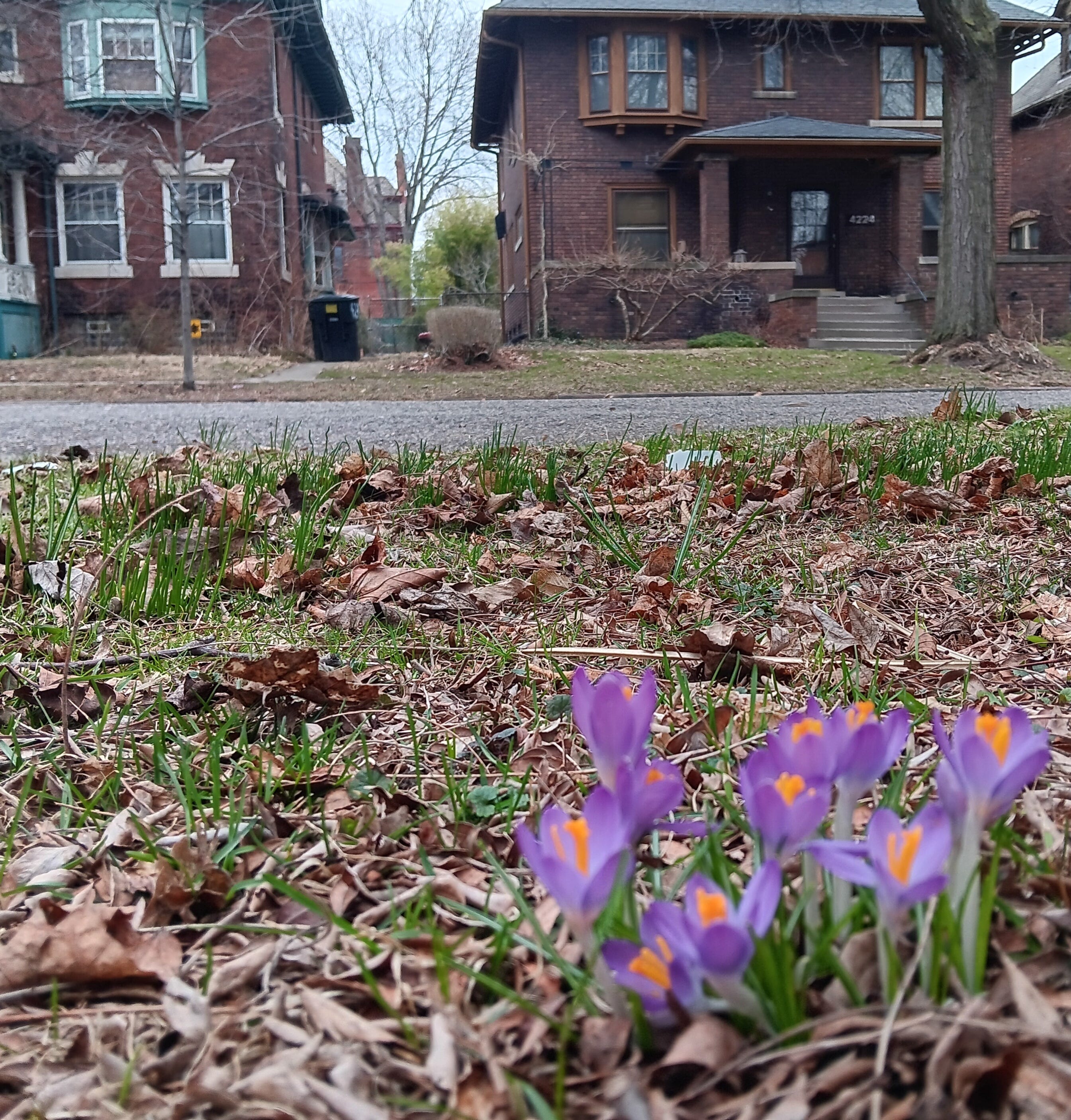
Not even Solomon in all his glory was clothed like the crocus.
The good shepherd preferred to be called “the human one.” In Hebrew, it is Kibor Enosh. Jim says it means something like “the vulnerable one who bears wounds.” What’s wild is that Enosh is the name of the son of Seth, God’s replacement for Abel after Cain kills him.
As the Kibor Enosh, Jesus intentionally roots himself in the line of Abel. He beckons us back to the beginning, to the first resister of civilization. The dark-skinned Palestinian Jew sides with the shepherds, not the settlers.
The message of Jesus is this: if you want soul strength, if you want to know the spiritual secrets, if you want to know the truth and learn what love is, break rank with the settlers and breathe with the shepherds.
Jesus waves the warning flag too: if you walk this path, entitled elites who are committed to Cain's supremacy stories will want to crucify you.
Towards the end of the Christian Scriptures, one passage says that, through faith, Abel still speaks. Which is weird, because in Genesis, Abel never speaks. He is muted and then murdered.
Jim says that Abel haunts the whole biblical tradition - and the rest of history too.
Abel still speaks, as a ghost, through the shared tears and shed blood of good shepherds like Jesus of Nazareth, Dr. King, Berta Caceres, Aysenur Ezgi Eygi, Hossam Shabat and so many others. These Abels still speak, beckoning us to boldly break rank with Cain’s supremacy stories too.
*********************
When the women went to the graveyard at dawn on Sunday morning to anoint the crucified body of the good shepherd, they found the stone rolled away and the tomb empty. Two men in dazzling clothes appeared and asked the women:
Why do you search
for the living
among the dead?
These words interrogate those of us devoted to spiritual depth, moral clarity and political courage in a civilization scripted by ideologies and institutions designed to deaden the deepest parts of who we are.
We do not have to go far to find what is alive and thriving. Something Else is hiding in plain sight. It is holing up right where the good shepherd said it would: in the non-human world that surrounds us and in all those considered less-than-human by civilized society.
The Abels of the world are still speaking.
************************
The roots of a radical revolution of values are right there on the first page of the resistance literature. Human beings are not civilized. We are sanctified. We all bask in the image of the divine, regardless of what we look like, where we were born, who we love, or how much we make.
Something Else is in serious tension with any civilization that selects a certain segment of the population to be considered inferior, to be sacrificed on the altar of power and profit, to be overworked or wiped out, to be duty-bound or deported.
To be civilized
or to be sanctified?
To follow Cain
or to follow Abel?
This is always the question - and it is magnified in this American moment.
The good news is that we are entangled with a world that really is enchanted. Even the wild goose has something to say. But we will never hear her unless we are willing to stop and breathe and become uncivilized.